martes, 12 de noviembre de 2019

LESSON 5.2 | HOW MUCH / HOW MANY: QUANTIFIERS

LESSON 5.2 | HOW MUCH / HOW MANY: QUANTIFIERS


How much? - How many?

English Grammar


When we want to know the quantity or amount of something, we ask questions starting with How much and How many.

HOW MUCH ...? - (Quantity)

How much is used with uncountable nouns.
HOW MUCH + UNCOUNTABLE NOUN
  • How much time do we have to finish the test?
  • How much money did you spend?
  • How much sugar would you like in your coffee?
  • How much paper will I need?
  • How much milk is in the fridge?
  • How much traffic was there on the way to work?
If the verb To Be is used with an uncountable noun, it is in singular form (= IS or WAS etc.)

HOW MUCH ...? - (Price)

How much can also be used when we want to know the PRICE of something.
In this case, we can use How much with countable nouns (both singular and plural nouns).
  • How much is that painting?
  • How much are those shoes?
  • How much did your jacket cost?
  • How much is the dress on display in the window?
  • How much will it cost me?
  • How much does it cost ?

HOW MANY ...? - (Quantity)

How many is used when we want to know the QUANTITY of something.
It is only used with plural countable nouns.
HOW MANY + PLURAL NOUN
  • How many days are there in January?
  • How many people work in your company?
  • How many cousins do you have?
  • How many books did you buy?
  • How many countries are there in the world?
  • How many students are in the class right now?
  • How many chairs are there in this room?
  • How many pieces of chocolate would you like?

Omitting the noun

Often the noun is omitted in the question when it is obvious what we are talking about.
A: I would like to buy some cheese. B: How much (cheese) would you like?
The noun cheese is not necessary after how much since we already know we are talking about cheese. In fact, it is normally omitted to avoid sounding repetitive.
More examples:
  • A: I need some coins. - B: How many do you need?
  • A: I need some sugar. - B: How much do you need?

Summary Chart
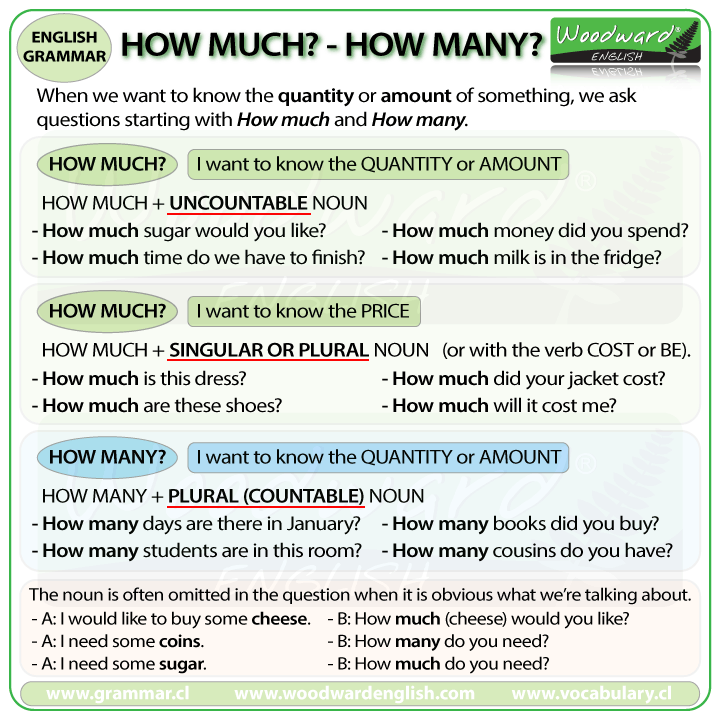
The difference between HOW MUCH and HOW MANY in English

Quantifiers
English Grammar


What are quantifiers?
Quantifiers tell us something about the amount or quantity of something (a noun).
Some quantifiers express a small or large quantity:
  • Small: I have a few things to do before finishing work.
  • Large: I have many things to do before finishing work.
Some quantifiers express part of or all of a quantity:
  • Part: It rains most days in winter.
  • All: It rained all day yesterday.
Quantifiers belong to a larger class called Determiner.
Examples of quantifiers
Quantifiers can be a single word (e.g. some) or a phrase (e.g. a lot of). Quantifiers that appear as a phrase are often called Complex Quantifiers.
Simple Quantifiers: all, another, any, both, each, either, enough, every, few, fewer, little, less, many, more, much, neither, no, several, some.
Complex Quantifiers: a few, a little, a lot of, lots of
The position of quantifiers
We put quantifiers at the beginning of noun phrases.
quantifier + noun
  • some people
quantifier + adjective + noun
  • many old books
quantifier + adverb + adjective + noun
  • a lot of very crazy drivers
We can also use quantifiers without a noun, like a pronoun.
  • These books are old but some are still in good condition. (Some refers to some books)
Quantifier + Noun
CHART COMING SOON
Formal and Informal Quantifiers
Sometimes we can make a sentence more formal or more informal (or natural) just by changing the quantifier.
Many people where invited to the wedding. (formal)
A lot of people arrived late. (informal/natural)
They made little progress. (formal)
They didn't make much progress.
(informal/natural)

HOMEWORK 5.1 (PARA CLASSROOM)


HOMEWORK 5.1

Work in your team, ask and answer questions, find out if any students have similar eating habits to you.

E.g.:
A: what do you usually eat for breakfast?
B: I always start with a coffee.
A: me, too. Black coffee.
B: do you? I usually have …

domingo, 10 de noviembre de 2019

LESSON 5.1 | COUNTABLES AND UNCOUNTABLES NOUNS (UNIT 5 ASO-SC1)

LESSON 5.1 | COUNTABLES AND UNCOUNTABLES (UNIT 5 ASO-SC1)

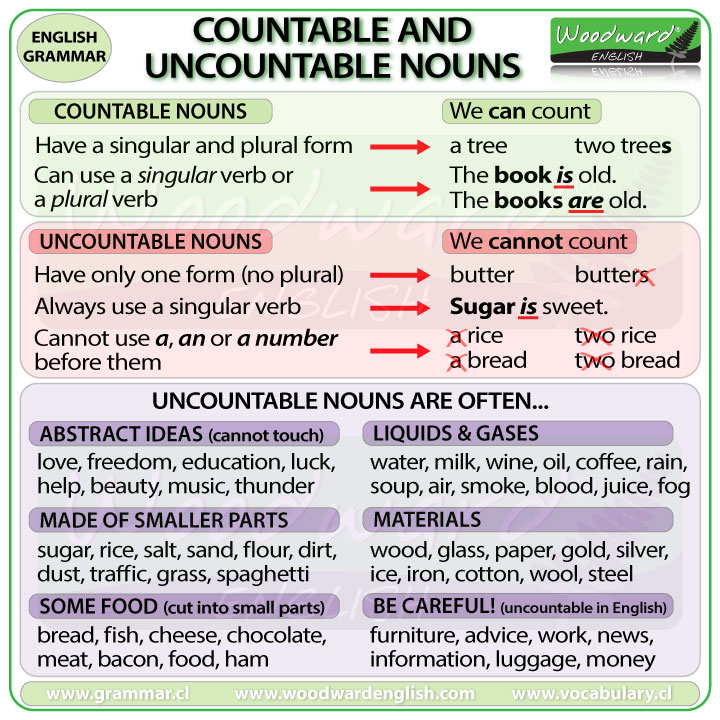
Countable vs. Uncountable Nouns

English Grammar Rules


A) Most nouns have singular and plural forms. They are countable nouns.
e.g. One letter, two letters
  • There is a letter on the table for you. (singular)
  • There are letters on the table for you. (plural)
B) Some nouns only have one form. They are uncountable nouns.
e.g. Money
  • There is no money in my bank account.
  • There is a lot of money in my bank account.
C) Many uncountable nouns refer to substances:
e.g. Chocolate, water, coffee, milk, sugar, salt, cheese, bread, rice, wood, glass, plastic, soap, toothpaste.
  • Do you have any chocolate?
  • The milk is sour - let's make cheese.
  • Rice is only edible when it has been cooked.
D) Many uncountable nouns refer to abstract ideas or emotions.
e.g. love, sadness, happiness, education, knowledge, and grammar.
  • Money can't buy love.
  • We like to experience happiness.
  • This education is priceless.
E) You can use a/an with singular countable nouns.
e.g. an umbrella, a wheel, a mistake.
  • It's raining so I need an umbrella.
  • I made a mistake.
  • This is a job for superman.
F) You can use plural countable nouns alone.
e.g. apples, bees, clouds.
  • There are clouds in the sky today.
  • There are bees making honey.
  • We eat apples for breakfast.
G) You can't use an article with an uncountable noun.
e.g. time, sand, electricity.
  • We need electricity to use our heater.
  • I lost track of time and we stayed up very late.
  • The beaches in Brazil have very nice sand.
H) It is very common in English to use some / any with plural nouns and uncountable nouns (Refer to grammar notes on Some Any for more details).
e.g. They don't listen to any advice.
  • We don't have any toys for the children.
  • There are many lessons in life, this is just one more.
  • It is important to have some knowledge of grammar.
I) There are a range of nouns that are uncountable in English but are countable in other languages.
These include: accommodation, advice, baggage, behaviour, bread, chaos, damage, furniture, information, luck, luggage, news, permission, progress, scenery, traffic, weather and work.
J) For comparison purposes, look at these sentences:
CountableUncountable
I'm looking for a job.I'm looking for work.
What a beautiful view!What beautiful scenery!
It's a nice day today.It's nice weather today.
We had a lot of bags and suitcases.We had a lot of luggage.
These chairs are mine.This furniture is mine.
It was a good suggestion.It was good advice.

Summary Chart

Countable and Uncountable Nouns in English

viernes, 1 de noviembre de 2019

SECOND PARTIAL PROJECT “BUYING IN A STORE”


SECOND PARTIAL PROJECT “BUYING IN A STORE”

       Primer paso:
       Cumplir con la tarea de la página 43 (homework 4.3)}
       Segundo paso:
       Elegir la la tienda
       Tercer paso:
       Escribir el guión / diálogo.
       Enviarlo al profesor a la fecha estipulada.
       CUARTO PASO:
       Presentar el proyecto / sketch con representación y utilería. 

Se podrá elegir qué tipo de concepto se pretende para su proyecto.
       Concepto 1:
       Dos tiendas y un cliente.
       Tres productos (o más) por cliente.
       Concepto 2:
       Dos clientes y una tienda.
       2 (o más) productos por cliente.
       ¾ de cuartilla/página de conversación(es)

RÚBRICA DE EVALUACIÓN.

miércoles, 23 de octubre de 2019

HOMEWORK 4.3 | speaking


HOMEWORK 4.3 | speaking

Look at the florchart. Use the prompts to complete the customer’s sentences.
(Después de completar ese diagrama de flujo en el libro o cuaderno, harás uno igual pero modificando los diálogos de ambos SALES CLERK y CUSTOMER)

NOTE: This activity will be send via GOOGLE CLASSROOM. 
NOTA: Esta actividad será entregada via GOOGLE CLASSROOM, ya no se aceptarán trabajos manuscritos en físico o papel carta. 


domingo, 20 de octubre de 2019

HOMEWORK 4.2 | SPEAKING


HOMEWORK 4.2

WORK IN PAIRS. TELL EACH OTHER ABOUT THE PLACES. WHICH PLACES WOULD YOU LIKE TO VISIT?

E.G.:
There is a good movie theater called THE RIALTO. It’s in the main square opposite the metro, next to the big pizza …

HOMEWORK 4.1 | SPEAKING


HOMEWORK 4.1 | SPEAKING

DESCRIBE BY HAND THE ROOMS AND THE POSITION OF THE FURNITURE OF YOUR HOUSE. THEN YOU HAVE TO DESCRIBE THE SAME WAY BUT THE HOUSE OR APARTMENT OF YOUR DREAMS. (CONSIDER USING “THERE IS, THERE ARE” AND PREPOSITIONS OF POSITION “IN, ON, IN FRONT OF”, ETC.)

E.G.:
It is my living room. There is a table under the window.

Some - Any - A - An

Some - Any - A - An English Grammar Rules Source:  https://www.grammar.cl/Notes/Some_Any_A_An.htm A and AN We use  A/AN  (arti...