martes, 8 de octubre de 2019

LESSON 3.3 | MAKING ARRANGEMENTS AND SUGGESTIONS.

LESSON 3.3 | MAKING ARRANGEMENTS AND SUGGESTIONS.

Making arrangements

Think about these points when the purpose of your email is to make an arrangement.

Useful questions

Here are some typical questions used for making arrangements:
  • Are you free next Tuesday afternoon?
  • What time would you like to meet?
  • When would be convenient for you?
  • Could you please let me know?

Expressions of time

Use on with days: Could we meet on Monday?
Use in with months, years and other expressions: I'm going to visit my grandparents in October.
Use at with times and other expressions: Could you please call me at 3pm?
Use next to refer to future times: I hope we can meet again next week.
Use when to start a future time clause: Let's meet again when it is convenient.

Tenses

To speak about a timetable, use the present simple: Next term runs from 1 September until 16 December.
To speak about a future arrangement, use the present continuous: Mr Toshiko is coming to our next meeting.
To speak about a plan, use 'be going to': Next term we are going to learn about pollution.
See the talking about the future page for more practice.

Tenses in complex sentences about the future

Use the present simple after whenif and next time in future time clauses:
  • I will call you when I get to the station.
  • I'm going to work with my dad when I finish school.
  • Let's go for a walk if the weather is good.
  • Will you visit the Eiffel Tower next time you are in Paris?

MAKING SUGGESTIONS. 


What Shall We Do?
In this exercise, two friends are trying to decide what to do for the weekend. By making suggestions, Jean and Chris make a decision that they're both happy with. See if you can identify where the suggestion is.
Jean: Hi Chris, would you like to do something with me this weekend?
Chris: Sure. What shall we do?
Jean: I don't know. Do you have any ideas?
Chris: Why don't we see a film?
Jean: That's sounds good to me. Which film shall we see?
Chris: Let's see "Action Man 4."
Jean: I'd rather not. I don't like violent films. How about going to "Mad Doctor Brown?" I hear it's quite a funny film.
Chris: OK. Let's go see that. When is it on?
Jean: It's on at 8 p.m. at the Rex. Shall we have a bite to eat before the film?
Chris: Sure, that sounds great. What about going to that new Italian restaurant Michetti's?
Jean: Great idea! Let's meet there at 6.
Chris: OK. I'll see you at Michetti's at 6. Bye.
Jean: Bye.
Chris: See you later!
When Jean says, "I'd rather not. I don't like violent films. How about going to 'Mad Doctor Brown?' I hear it's quite a funny film," he is making a suggestion.

More Practice
Once you've mastered the dialogue above, challenge yourself with some additional role-playing exercises. What suggestions would you make if a friend said to you:
  • Why don't you/we go to the movies tonight?
  • You/we could visit New York while you're/we're there.
  • Let's go to the travel agent's this afternoon to book our ticket.
  • What about asking your brother for help?
  • How about going to Hawaii for your vacation?
  • I suggest you/we take all the factors into consideration before we decide.
Before answering, think about your response. What will you suggest? What related information should you tell your friend? Think about the necessary details, such as time or location.
Key Vocabulary
If you're being asked to make a decision, that suggestion usually comes in the form of a question. For example:
  • Would you like to...?
  • (What) shall we go...?
If someone else has made a decision and they want your opinion, it may be made as a statement instead. For example: 
  • Let's go...
  • Why don't we go...
  • How about going...
  • What about going...

LESSON 3.2 | FREQUENCY ADVERBS

LESSON 3.2 | FREQUENCY ADVERBS

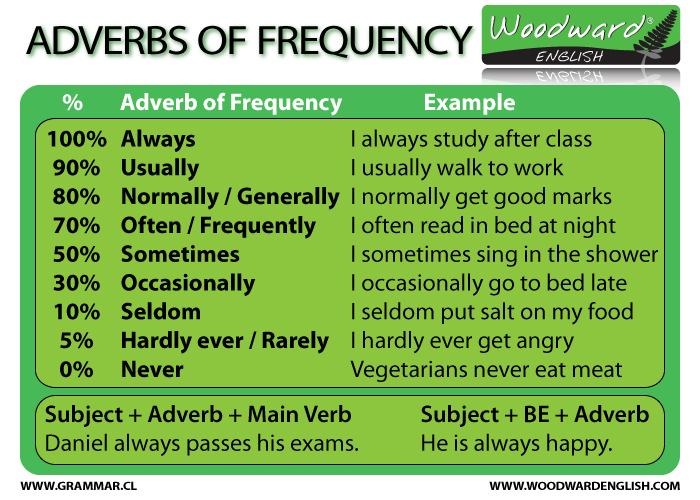
Adverbs of Frequency

English Grammar Rules

We use some adverbs to describe how frequently we do an activity.
These are called adverbs of frequency and include:
FrequencyAdverb of FrequencyExample Sentence
100%alwaysalways go to bed before 11 p.m.
90%usuallyusually have cereal for breakfast.
80%normally / generallynormally go to the gym.
70%often* / frequentlyoften surf the internet.
50%sometimessometimes forget my wife's birthday.
30%occasionallyoccasionally eat junk food.
10%seldomseldom read the newspaper.
5%hardly ever / rarelyhardly ever drink alcohol.
0%nevernever swim in the sea.
* Some people pronounce the 'T' in often but many others do not.
These are also known as Adverbs of INDEFINITE frequency as the exact frequency is not defined.

The Position of the Adverb in a Sentence

An adverb of frequency goes before a main verb (except with To Be).
Subject + adverb + main verb
always remember to do my homework.
He normally gets good marks in exams.

An adverb of frequency goes after the verb To Be.
Subject + to be + adverb
They are never pleased to see me.
She isn't usually bad tempered.

When we use an auxiliary verb (have, will, must, might, could, would, can, etc.), the adverb is placed between the auxiliary and the main verb. This is also true for to be.
Subject + auxiliary + adverb + main verb
She can sometimes beat me in a race.
would hardly ever be unkind to someone.
They might never see each other again.
They could occasionally be heard laughing.

We can also use the following adverbs at the start of a sentence:
Usually, normally, often, frequently, sometimes, occasionally
  • Occasionally, I like to eat Thai food.
BUT we cannot use the following at the beginning of a sentence:
Always, seldom, rarely, hardly, ever, never.

We use hardly ever and never with positive, not negative verbs:
  • She hardly ever comes to my parties.
  • They never say 'thank you'.
We use ever in questions and negative statements:
  • Have you ever been to New Zealand?
  • I haven't ever been to Switzerland. (The same as 'I have never been Switzerland').

Adverbs of Frequency in English

Adverbs of Definite Frequency

We can also use the following expressions when we want to be more specific about the frequency:
  • every day
  • once a month
  • twice a year
  • four times a day
  • every other week
  • daily
  • monthly
These are also known as Adverbs of DEFINITE frequency as the exact frequency is specified.
See our video for details about these types of Adverbs:


domingo, 6 de octubre de 2019

LESSON 3.1 | HAVE / HAS (UNIT 3 - ASO EL SC 1)


LESSON 3.1 | HAVE / HAS

Have - Has - Go - Goes
Simple Present Tense


Conjugation of Have and Go
To Have = To show possession / a quality
To Go = to show movement (travel) in a specific direction

Subject
To Have
The Rest of the sentence
I / you / we / they
have
an old bike.
he / she / it
has
a new car.

Subject
To Go
The Rest of the sentence
I / you / we / they
go
to class every day.
he / she / it
goes
to the movies on Friday.
Usually we only add 'S' to a verb when we conjugate it in the third person but notice how To Have and To Go are slightly irregular (though they still both end in S).


Have and Go in Negative Sentences
To make a negative sentence in English with To Have and To Go we use Don't or Doesn't followed by Have or Go (never Has or Goes).
Affirmative: You have a pen.
Negative: You don't have a pen.
You will see that we add don't between the subject and the verb. We use Don't when the subject is Iyouwe or they.
Affirmative: He has a pencil.
Negative: He doesn't have a pencil.
When the subject is heshe or it, we add doesn't between the subject and the verb to make a negative sentence. Notice that we don't use the normal third person conjugation (has, goes) in negative sentences. We use the base form of the infinitive as seen below.


Word Order of Negative Sentences
The following is the word order to construct a basic negative sentence in English in the Present Tense using Don't or Doesn't.
Subject
don't/doesn't
To Have*
The Rest of the sentence
I / you / we / they
don't
have
cereal for lunch.
he / she / it
doesn't

Subject
don't/doesn't
To Go*
The Rest of the sentence
I / you / we / they
don't
go
to classes every day.
he / she / it
doesn't
* Verb: The verb that goes here is the base form of the infinitive = The infinitive without TO before the verb. Instead of the infinitive To have it is just the have part.
Remember that the infinitive is the verb before it is conjugated (changed) and it begins with TO. For example: to have, to eat, to go, to live, to speak etc.
Examples of Negative Sentences with Have:
  • You don't have a clue.
  • John doesn't have many friends.
  • We don't have time for a rest.
  • It doesn't have four wheels.
  • They don't have the correct answers.
  • She doesn't have a nice dress.
Examples of Negative Sentences with Go:
  • You don't go to university.
  • John doesn't go to parties.
  • We don't go to work on the weekend.
  • It doesn't go fast.
  • They don't go to the beach.
  • She doesn't go to church.


Questions with Have and Go
To make a question in English with To Have and To Go, we normally use Do or Does at the beginning of the question.
Affirmative: You have a girlfriend.
Question: Do you have a girlfriend?
You will see that we add DO at the beginning of the affirmative sentence to make it a question. We use Do when the subject is Iyouwe or they.
Affirmative: She has a boyfriend.
Question: Does she have a boyfriend?
When the subject is heshe or it, we add DOES at the beginning to make the affirmative sentence a question. Notice that we don't use the normal third person conjugation (has, goes) in questions. We use the base form of the infinitive as seen below.


Word Order of Questions with Do and Does
The following is the word order to construct a basic question in English using Do or Does.
Do/Does
Subject
Verb*
The Rest of the sentence
Do
I / you / we / they
have
a new bike?
Does
he / she / it

Do/Does
Subject
Verb*
The Rest of the sentence
Do
I / you / we / they
go
to school?
Does
he / she / it
*Verb: The verb that goes here is the base form of the infinitive = The infinitive without TO before the verb. Instead of the infinitive To have it is just the have part.
Remember that the infinitive is the verb before it is conjugated (changed) and it begins with TO. For example: to have, to eat, to go, to live, to speak etc.
Examples of Questions with Have and Go:
  • Do you have a dictionary?
  • Does Mary have a dictionary?
  • Do we go to all the meetings?
  • Does she go to all the meetings?


Short Answers with Have and Go
In questions that use do/does it is possible to give short answers to direct questions as follows:
Sample Questions
Short Answer
(Affirmative)
Short Answer
(Negative)
Do you have a car?
Do you go to church?
Yes, I do.
No, I don't.
Do I have time?
Do I go to work today?
Yes, you do.
No, you don't.
Do you both have time?
Do you both go to school?
Yes, we do.
No, we don't.
Do they have a car?
Do they go to the pub?
Yes, they do.
No, they don't.
Does he have a car?
Does he go to university?
Yes, he does.
No, he doesn't.
Does she have a car?
Does she go to the gym?
Yes, she does.
No, she doesn't.
Does it have four wheels?
Does it go slow?
Yes, it does.
No, it doesn't.


Some - Any - A - An

Some - Any - A - An English Grammar Rules Source:  https://www.grammar.cl/Notes/Some_Any_A_An.htm A and AN We use  A/AN  (arti...