martes, 24 de septiembre de 2019

PARTIAL ONE PROJECT / PROYECTO DE PRIMER PARCIAL.


PARTIAL ONE PROJECT
In order to start the project, you’d better answer these questions first.

What kind of services does your tour offer? (AND NAME)
What time do they start?
What time do they finish?
How much do they cost?
What routes do they take?
What interesting places can you visit or go past?

viernes, 20 de septiembre de 2019

LESSON 2.3 | PREPOSITIONS AT, IN, ON.

LESSON 2.3 | PREPOSITIONS AT, IN, ON. 

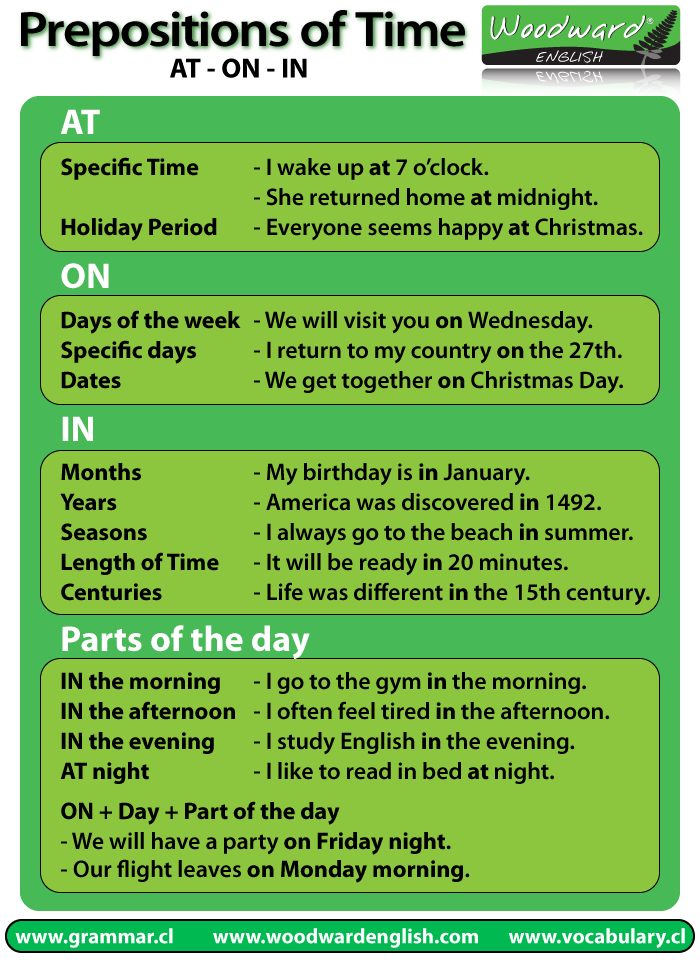
AT - ON - IN - Prepositions of Time

English Grammar Rules

AT

We use AT with specific times (hour / minutes):
  • I get up at 7 o'clock.
  • My English class starts at 10am.
  • She finishes work at 6.15
  • I left the party at midnight.
Midnight (and midday) is a specific hour which is why we use AT.
12am = midnight
12pm = midday / noon
We use AT for a holiday period of two or more days:
  • Do you normally get together with your relatives at Christmas?
  • Did you eat a lot of chocolate at Easter?

ON

We use ON for specific days and dates:
  • I will return it to you on Wednesday.
  • They got married on Friday the 13th.
  • We get paid on the 20th of every month.
  • I drank too much milk on New Year's eve.
Remember that for dates, we use ordinal numbers.
E.g. the First of September (not the one of September)

IN

We use IN for specific months, years, seasons, centuries and lengths of time.
  • My birthday is in January. (I don't mention the date, just the month)
  • My grandmother was born in 1927.
  • The river near my house is dry in Summer.
  • The company was founded in the 19th century.
  • We need to have this report ready in 15 minutes.
Compare:
The New Zealand National day is in February.
(I don't mention the day - only the month)
The New Zealand National day is on February 6th.
(I mention the day - the order is not important)

Prepositions of Time At On In

The Weekend

Sometimes you will hear AT the weekend and sometimes ON the weekend.
They are both correct. ON the weekend is used in United States.
  • Where did you go on the weekend? (American English)
  • Where did you go at the weekend? (British English)
See our video about: AT the weekend vs. ON the weekend

We don't use Prepositions

Remember! We do not use at, on, in or the with the following expressions:
  • Today, tomorrow, yesterday, this morning, tonight, last, next, every.

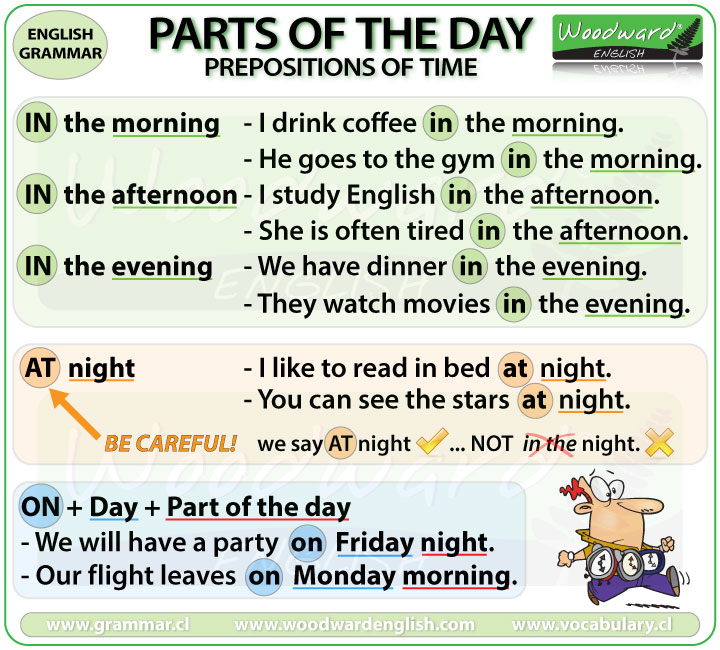
Prepositions with Parts of the Day

The prepositions AT, ON, IN with parts of the day - English grammar rules

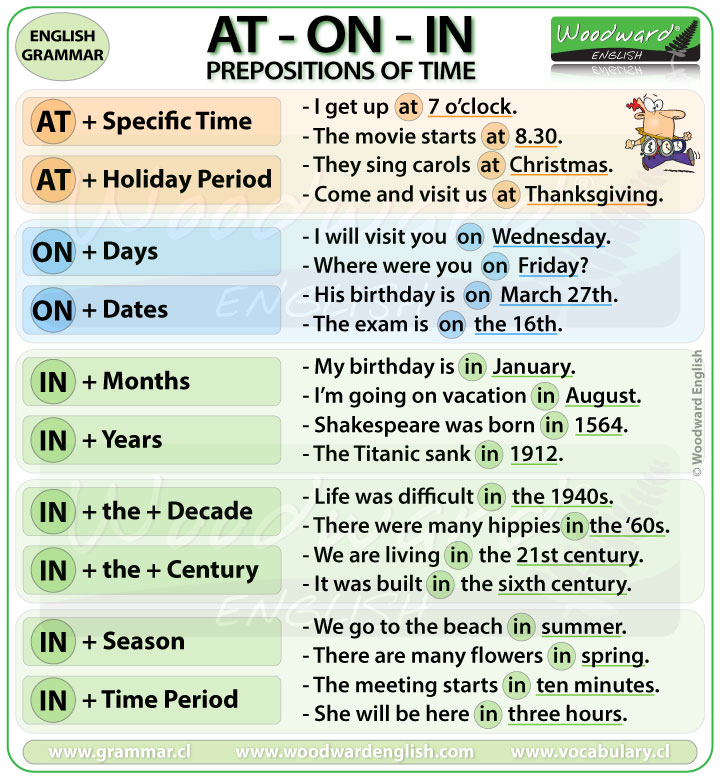
Prepositions of Time Chart

I have updated the old green AT ON IN chart (it was one of the first charts I did as I was learning how to create them) to the newer version below which I created for our video.
AT ON IN - Prepositions of Time in English

LESSON 2.3 | ASKING FOR INFORMATION

LESSON 2.3 | ASKING FOR INFORMATION
·         Asking for information


Sometimes you want to ask English people for information. In English it is not very polite to start a conversation with a direct question. For this reason we have a number of phrases.
10 expressions to Use In Speaking And Writing: 
Can you tell me...?
Could you tell me...?
I'd like to know...
D'you know...
(Got / Have you) any idea...?
Could anyone tell me...?
(Do / Would) you happen to know...?
I don't suppose you (would) know...?
I wonder if you could tell me...?
I wonder if someone could tell me...?


How To Use These Phrases In Your English: 
Phrases 1 - 10 are all followed by indirect questions. So 'What's the time?' becomes 'Can you tell me what the time is?'.
Phrase 2 is a little more formal and polite than phrase 1.
Phrases 3, 6, 7, 8, 9 and 10 are polite and are good to use if you are asking a stranger or you are asking at a public information desk.
Phrase 4 is more informal.
Phrases 5 and 7 are more informal if you say them with out the part in () brackets.
Phrases 9 and 10 are very formal and in an informal situation some people may react strangely if they think that you are being sarcastic.
By using phrases 1 to 10, we make it easier for the listener to say 'Sorry I don't know'.

LESSON 2.1 & 2.2 | SIMPLE PRESENT (UNIT 2)

SIMPLE PRESENT


EL "SIMPLE PRESENT" SE UTILIZA:

  • Para expresar hábitos y rutinas, hechos generales, acciones repetidas o situaciones, emociones y deseos permanentes:
    I smoke (hábito); I work in London (permanencia); London is a large city (hecho general)
  • Para dar instrucciones o indicaciones:
    You walk for two hundred meters, then you turn left.
  • Para hablar de eventos programados, presentes o futuros:
    Your exam starts at 09.00.
  • Para referirse al futuro, detrás de algunas conjunciones: after, when, before, as soon as, until:
    He'll give it to you when you come next Saturday.
¡Cuidado! El "simple present" no se utiliza para hablar de lo que está ocurriendo en este momento.

EJEMPLOS

  • Hábitos y rutinas
    He drinks tea at breakfast.
    She only eats fish.
    They watch television regularly.
  • Eventos y acciones repetidos
    We catch the bus every morning.
    It rains every afternoon in the hot season.
    They drive to Monaco every summer.
  • Hechos generales
    Water freezes at zero degrees.
    The Earth revolves around the Sun.
    Her mother is Peruvian.
  • Instrucciones o indicaciones
    Open the packet and pour the contents into hot water.
    You take the No.6 bus to Watney and then the No.10 to Bedford.
  • Eventos programados
    His mother arrives tomorrow.
    Our holiday starts on the 26th March
  • Construcciones de futuro
    She'll see you before she leaves.
    We'll give it to her when she arrives.

FORMACIÓN DEL "SIMPLE PRESENT": TO THINK

AfirmativaInterrogativaNegativa
I thinkDo I think?I do not think
You thinkDo you think?You do not think
He thinksDoes he think?He does not think
She thinksDoes she think?She does not think
It thinksDoes it think?It does not think
We thinkDo we think?We do not think.
They thinkDo they think?They do not think.

NOTAS SOBRE LA TERCERA PERSONA DEL SINGULAR DEL "SIMPLE PRESENT"

  • En la tercera persona del singular, el verbo siempre termina en -s:
    he wants, she needs, he gives, she thinks.
  • Para las formas negativa e interrogativa, se emplea DOES (= tercera persona del auxiliar 'DO') + el infinitivo del verbo.
    He wants ice cream. Does he want strawberry? He does not want vanilla.
  • Verbos que terminan en -y : en la tercera persona del singular, se cambia la -y por -ies:
    fly --> flies, cry --> cries
    Excepción: cuando una vocal precede a la -y:
    play --> plays, pray --> prays
  • Añadimos -es a los verbos que terminan en:-ss, -x, -sh, -ch:
    he passes, she catches, he fixes, it pushes
EJEMPLOS
  • He goes to school every morning.
  • She understands English.
  • It mixes the sand and the water.
  • He tries very hard.
  • She enjoys playing the piano.

martes, 3 de septiembre de 2019

CRITERIOS DE EVALUACIÓN PARA LA CLASE INGLÉS I (SEGUNDO Y TERCERO PARCIAL)

CRITERIOS DE EVALUACIÓN PARA LA CLASE INGLÉS I (SEGUNDO Y TERCERO PARCIAL) 

Los criterios de evaluación para el primer cuatrimestre, modo escolarizado de UVA campus Saltillo en la asignatura de inglés I para alumnos de primer cuatrimestre modo escolarizado son los siguientes:

EXAMEN PARCIAL = 40%
PARTICIPACIÓN = 10% 
TRABAJO EN CLASE = 20%
PROYECTO O EXAMEN ORAL = 20%
TAREAS O ASIGNACIONES DOMÉSTICAS = 10%

NOTA: Si tuviste más de 3 asistencias eso representa un detrimento en tu evaluación, porque después de 5 faltas cada inasistencia representa de tres hasta 6 décimas de punto de tu promedio de parcial.

CRITERIO EN MATERIA DE FALTAS Y RETARDOS.
LA TOLERANCIA DE RETARDOS O DEMORAS DE ASISTENCIA son 3 veces, a partir del tercer retardo se convierte inmediatamente en una falta.
La tolerancia de faltas para tener derecho al examen parcial o mensual es de 5 faltas, al rebasar ese número su derecho a la prueba se anula por completo perdiendo así la oportunidad de cumplir con el 40% de su evaluación parcial.


PUEDES
NO PUEDES

EXAMEN MENSUAL (PARCIAL)

Faltar 5 veces
6 o más faltas

EXAMEN FINAL

15 insasistencias máximo
16

EXAMEN EXTRAORDINARIO

16 – 20 inasistencias máximo
21

EXAMEN DE TITULO DE INSUFICIENCIA

21 - 25 inasistencias
26

RECURSAR

26 inasistencias o más


sábado, 31 de agosto de 2019

LESSON 1.3 | MAKING REQUESTS (ASO EL 1 - UNIT 1)

LESSON 1.3 | MAKING REQUESTS (ASO EL 1 - UNIT 1)

MAKING REQUESTS


Can
Could
I
Have
A sándwich, please?
One of those batteries, please?
A round trip ticket to Paris, please?


Use Can/Could + / + infinitive to make requests.

Note: could is often formal and polite than can.

Reply. Yes, of course. Here you are.


VIDEO ACERCA DEL TEMA (CONTIENE INFORMACIÓN PARA AVANZADOS)

LESSON 1.2 (PART 4) | POSSESSIVE 'S (ASO EL 1 - UNIT 1)

Possession (John’s car, a friend of mine)

Possessive ’s

We use apostrophe s (’s), also called possessive ’s, as a determiner to show that something belongs to someone or something:
Is that Olivia’s bag?
Britain’s coastline is very beautiful.
We can also use it in complex noun phrases (underlined):
Greg is her youngest daughter’s husband.
We can use two possessive ’s constructions in the same noun phrase:
We went to Jake’s father’s funeral.
We also use possessive ’s to talk about time and duration:
Is that yesterday’s paper?
I’ve only had one week’s holiday so far this year.

Rules for using possessive ’s

We use ’s after a singular noun and ’ after a plural noun.
Compare

singular noun + ’s
plural noun + ’
The girl’s bedroom
(The bedroom belongs to one girl.)
The girls’ bedroom.
(The bedroom belongs to more than one girl.)
We use ’s with irregular plural nouns (e.g. children, men, people, women):
The children’s parents decided which university they would go to.
They have no respect for other people’s property.
The rules for the pronunciation of a noun with ’s are the same as the rules for pronunciation of plural forms of nouns.
Compare

noun + ’s or ’
plural noun
pronunciation
The cat’s dinner is in the fridge.
The cats were running around the garden.
/s/
The kids’ uncle gave them all some money.
The kids are getting impatient.
/z/
George’s brother was there.
There are three Georges in my family.
/ɪz/
When a first or second name ends in -s, we can either add ’ or ’s. It is more common to use ’ than ’s. When we speak, we usually pronounce the final part of the word as /zɪz/ or /sɪz/:
Is that James’ car? (or Is that James’s car?) (both usually pronounced /ˈdʒeɪmzɪz/)
I love Keats’ poetry. (or I love Keats’s poetry.) (both usually pronounced /ˈki:tsɪz/)
With compound nouns, we add ’s to the final noun:
My sister-in-law’s friend came with us.
Not: My sister’s-in-law friend
We don’t usually use the possessive ’s with things:
the door handle
Not: the door’s handle
the shop window
Not: the shop’s window
the kitchen table
Not: the kitchen’s table
Spoken English:
When we talk about places which are familiar to the speaker and the listener, we sometimes don’t use the noun after possessive ’s:
the hairdresser’s salon – the hairdresser’s
the doctor’s surgery – the doctor’s
We had to take our cat to the vet’s twice last month. (the same as: We had to take our cat to the vet’s clinic twice last month.)
Do you shop in Marks and Spencer’s?
We decided to go to John’s after the cinema. (the same as: We decided to go to John’s house after the cinema.)
In short answers, we can omit the noun if it is not necessary to repeat it:
A:
Is that your coat?
B:
No, it’s Sandra’s.
We use possessive ’s with words such as one, anyone, someone, anybody, somebody:
It’s important to know one’s rights as a tenant.
Is this someone’s coat here?
When we use else with these words, the ’s is added to else:
Why didn’t you come? Everyone else’s husband was there.
Warning:
The pronoun other has the same forms as nouns. We add ’s to the singular form, and we add an apostrophe after the plural -s ending in the plural form:
They took each other’s hand and started walking.
All of our luggage arrived but the others’ cases didn’t. The airline promise they will be here this evening.
Warning:
We don’t use ’s with possessive pronouns:
Is that dog yours?
Not: Is that dog your’s?
I think that car is theirs.
Not: I think that car is theirs’
We don’t use ’s with the possessive determiner its. It’s means ‘it is’:
The city is proud of its parks.
Not: The city is proud of it’s parks.

Possessives with of

Noun phrase + of + possessive pronoun

We can talk about possession using the pattern: noun phrase + of + possessive pronoun:
A friend of mine told me that all of the tickets have already sold out.
A:
Where’s Martin?
B:
He’s gone to pick up a cousin of his at the station.
Is Linda McGrath a close friend of yours?
Warning:
We use a possessive pronoun, not the object form of the pronoun:
A neighbour of mine called late last night.
Not: A neighbour of me …

Noun phrase + of + possessive ’s noun phrase

We can also use the noun phrase + of pattern before a noun phrase with possessive ’s:
He’s a brother of Maria’s.
A friend of my sister’s has opened a café on Dawson Street.
She was a daughter of the President’s.

’s or of or either?

There are some general rules about when to use ’s and when to use of but there are many cases where both are possible:
The film’s hero or The hero of the film
The car’s safety record or The safety record of the car
The report’s conclusion or The conclusion of the report
Sometimes when we first mention a noun, we use of, and later when we refer to it again, we use ’s:
The mountains of Pakistan are mostly in the north. At least one hundred of them are above 7,000 metres … Most of Pakistan’s mountains are in the spectacular Karakoram range.

When we don’t use ’s

We don’t use ’s when the noun is not a person, animal, country, organisation, etc., or when the noun phrase is very long:
The name of the ship was ‘Wonder Queen’. (preferred to The ship’s name was ‘Wonder Queen’.)
The house of the oldest woman in the village. (preferred to The oldest woman in the village’s house.)

When we don’t use of

When we are talking about things that belong to us, relationships and characteristics of people, animals, countries, categories, groups or organisations made up of people, we usually use ’s:
The men’s dressing room is on the left at the end of the corridor.
Not: The dressing room of the men …
The cat’s paw was badly cut.
Not: The paw of the cat …

Possession: typical errors

  • We don’t use ’s with plural nouns:
It’s my responsibility to deal with customers’ complaints.
Not: … to deal with customers's complaints.
  • The possessive determiner its has no apostrophe:
We bought this car because we liked its colour.
Not: … because we liked it’s colour.
  • We don’t use ’s to make nouns plural. When we want to show that something is plural, we add -s without an apostrophe:
They had to rebuild the roads after the earthquake.
Not: They had to rebuild the road’s …

Some - Any - A - An

Some - Any - A - An English Grammar Rules Source:  https://www.grammar.cl/Notes/Some_Any_A_An.htm A and AN We use  A/AN  (arti...