jueves, 28 de noviembre de 2019

List of regular verbs in English


List of regular verbs in English

Here you will find a list of common English regular verbs. 
An alphabetical list of English regular verbs 

Infinitive
Past simple and Past perfect
Act
Acted
Add
Added
Aid
Aided
Arrest
Arrested
Assist
Assisted
Attend
Attended
Address
Addressed
Advertise
Advertised
Amuse
Amused
Approach
Approached
Ask
Asked
Accompany
Accompanied
Accustom
Accustom
Agree
Agreed
Annoy
Annoyed
Answer
Answered
Appeal
Appealed
Appear
Appeared
Arrange
Arranged
Arrive
Arrived
Board
Boarded
Balance
Balanced
Banish
Banished
Bark
Barked
Bless
Blessed
Brush
Brushed
Behave
Behaved
Belong
Belonged
Beg
Begged
Believe
Believed
Boil
Boiled
Breathe
Breathed
Boost
Boosted
Call
Called
Care
Cared
Carry
Carried
Choke
Choked
Change
Changed
Check
Checked
Charge
Charged
Clean
Cleaned
Climb
Climbed
Comb
Combed
Complete
Completed
Consist
Consisted
Count
Counted
Cover
Covered
Close
Closed
Cook
Cooked
Crash
Crashed
Craw
Crawl
Cross
Crossed
Cry
Cried
Cool
Cooled
Dance
Danced
Dare
Dared
Declare
Declared
Delay
Delayed
Deliver
Delivered
Deny
Denied
Dial
Dialled
Die
Died
Dine
Dined
Drag
Dragged
Dress
Dressed
Drop
Dropped
Dry
Dried
Enclose
Enclosed
Enjoy
Enjoyed
Engage
Engaged
Envy
Envied
Ease
Eased
Erase
Erased
Exchange
Exchanged
Express
Expressed
Exclaim
Exclaimed
Explain
Explained
Fail
Failed
Fasten
Fastened
File
Filed
Fill
Filled
Fish
Fished
Finish
Finished
Fire
Fired
Fix
Fixed
Follow
Followed
Frighten
Frightened
Fry
Fried
Gain
Gained
Guess
Guessed
Happen
Happened
Help
Helped
Hunt
Hunted
Hurry
Hurried
Imagine
Imagined
Iron
Ironed
Judge
Judged
Kiss
Kissed
Kill
Killed
Laugh
Laughed
Leak
Leaked
Like
Liked
Lock
Locked
Look
Looked
Love
Loved
Mark
Marked
Milk
Milked
Miss
Missed
Manage
Managed
Marry
Married
Massage
Massaged
Measure
Measured
Move
Moved
Observe
Observed
Offer
Offered
Open
Opened
Order
Ordered
Park
Parked
Pass
Passed
Perform
Performed
Phone
Phoned
Pick
Picked
Plan
Planed
Play
Played
Please
Pleased
Plough
Ploughed
Polish
Polished
Pour
Poured
Practice
Practiced
Pray
Prayed
Prefer
Preferred
Promise
Promised
Pronounce
Pronounced
Pull
Pulled
Punish
Punished
Push
Pushed
Repeat
Repeated
Report
Reported
Request
Requested
Rest
Rested
Reach
Reached
Refuse
Refused
Raise
Raised
Rain
Rained
Realize
Realized
Register
Registered
Receive
Received
Remain
Remained
Remember
Remembered
Repair
Repaired
Require
Required
Reserve
Reserved
Row
Rowed
Resolve
Resolved
Return
Returned
Save
Saved
Search
Searched
Serve
Served
Settle
Settled
Sign
Signed
Slap
Slapped
Slip
Slipped
Smile
Smiled
Smoke
Smoked
Snow
Snowed
Spill
Spilled
Stage
Staged
Stay
Stayed
Stretch
Stretched
Stop
Stopped
Study
Studied
Suffer
Suffered
Swallow
Swallowed
Switch
Switched
Tackle
Tackled
Talk
Talked
Thank
Thanked
Tire
Tired
Touch
Touched
Trap
Trapped
Train
Trained
Travel
Travelled
Trouble
Troubled
Try
Tried
Turn
Turned
Use
Used
Unpack
Unpacked
Visit
Visited
Wait
Waited
Walk
Walked
Wash
Washed
Watch
Watched
Warm
Warmed
Warn
Warned
Water
Watered
Weigh
Weighed
Wish
Wished
Work
Worked
Wreck
Wrecked


domingo, 24 de noviembre de 2019

Past Tense Irregular Verbs List

Past Tense Irregular Verbs List

English Grammar Rules

Part One

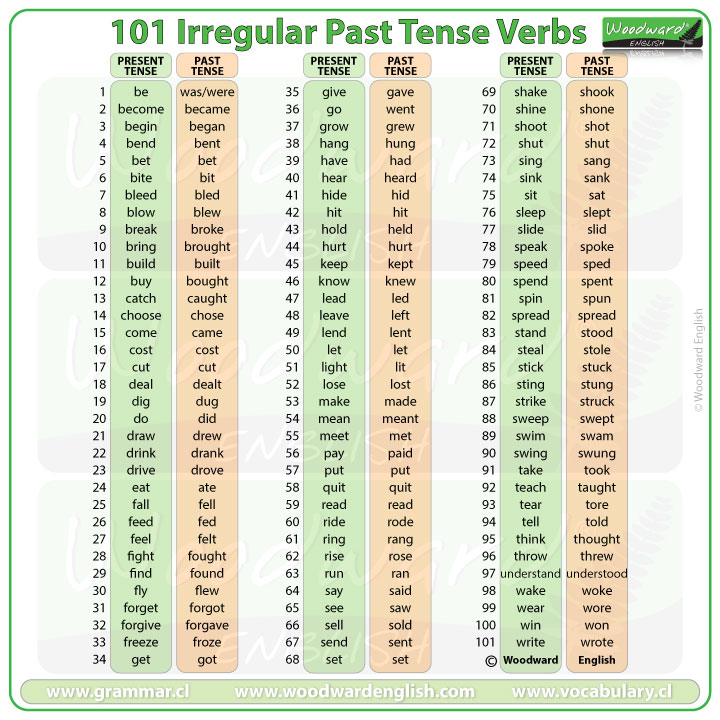
The following is a list of Irregular Verbs in English:
VerbPast SimplePast Participle
arisearosearisen
babysitbabysatbabysat
bewas / werebeen
beatbeatbeaten
becomebecamebecome
bendbentbent
beginbeganbegun
betbetbet
bindboundbound
bitebitbitten
bleedbledbled
blowblewblown
breakbrokebroken
breedbredbred
bringbroughtbrought
broadcastbroadcastbroadcast
buildbuiltbuilt
buyboughtbought
catchcaughtcaught
choosechosechosen
comecamecome
costcostcost
cutcutcut
dealdealtdealt
digdugdug
dodiddone
drawdrewdrawn
drinkdrankdrunk
drivedrovedriven
eatateeaten
fallfellfallen
feedfedfed
feelfeltfelt
fightfoughtfought
findfoundfound
flyflewflown
forbidforbadeforbidden
forgetforgotforgotten
forgiveforgaveforgiven
freezefrozefrozen
getgotgot (BrE)
gotten (AmE)
givegavegiven
gowentgone
growgrewgrown
hang*hunghung
havehadhad
hearheardheard
hidehidhidden
hithithit
holdheldheld
hurthurthurt
keepkeptkept
knowknewknown
laylaidlaid
leadledled
leaveleftleft
lendlentlent
letletlet
lie **laylain
lightlitlit
loselostlost
makemademade
meanmeantmeant
meetmetmet
paypaidpaid
putputput
quitquitquit
read ***readread
rideroderidden
ringrangrung
riseroserisen
runranrun
saysaidsaid
seesawseen
sellsoldsold
sendsentsent
setsetset
shakeshookshaken
shineshoneshone
shootshotshot
showshowedshown
shutshutshut
singsangsung
sinksanksunk
sitsatsat
sleepsleptslept
slideslidslid
speakspokespoken
speedspedsped
spendspentspent
spinspunspun
spreadspreadspread
standstoodstood
stealstolestolen
stickstuckstuck
stingstungstung
strikestruckstruck
swearsworesworn
sweepsweptswept
swimswamswum
swingswungswung
taketooktaken
teachtaughttaught
teartoretorn
telltoldtold
thinkthoughtthought
throwthrewthrown
understandunderstoodunderstood
wakewokewoken
wearworeworn
winwonwon
withdrawwithdrewwithdrawn
writewrotewritten
* HANG - Hang has two different meanings. The first is "to attach (or hang) something in a high position" (e.g. on the wall or on a hook). In this case we use the above verbs Hang-Hung-Hung.
BUT when Hang means "to kill someone by putting a rope around someone's neck and leaving them in a high position without any support", we use different verbs: Hang-Hanged-hanged. This verb is typical of public executions in the past. (e.g. They hanged him in the main square.)
** LIE - Lie has two meanings. When it means "to put your body in a horizontal position" (normally on a bed) it uses the Lie-Lay-Lain verbs.
BUT it is regular Lie-Lied-Lied when it has the other meaning of "not to say the truth".
*** READ - Even though they are written the same, the pronunciation is different in the Past Tense and Past Participle form.

Part Two

The following verbs can be regular or irregular:
VerbPast SimplePast Participle
burnburned OR burntburned OR burnt
dreamdreamed OR dreamtdreamed OR dreamt
learnlearned OR learntlearned OR learnt
smellsmelled OR smeltsmelled OR smelt
The second form (burnt, dreamt etc.) is more common in British English.

Part Three

Verbs that have the same form in Present, Past and Past Participle form:
VerbPast SimplePast Participle
betbetbet
broadcastbroadcastbroadcast
cutcutcut
hithithit
hurthurthurt
letletlet
putputput
quitquitquit
readreadread
setsetset
shutshutshut
spreadspreadspread
All of the verbs above are written and pronounced the same in the three forms EXCEPT for Read which is written the same but pronounced differently.

101 Irregular Past Tense Verbs in English

101 Irregular Past Tense Verbs in English

LESSON 6.2 | PAST TENSE

LESSON 6.2 | PAST TENSE

Simple Past Tense

English Grammar

The Simple Past Tense, often just called the Past Tense, is easy to use in English.
If you already know how to use the Present Tense, then the Past Tense will be easy.
In general, the Past Tense is used to talk about something that started and finished at a definite time in the past.

How to form the Past Tense in English

The main rule is that for every verb in English, there is only one form of it in the past tense.
(The exception is the Past tense of To Be, which has two forms: was and were)
This is totally different from other languages such as Spanish, French, Italian etc. where you change the verb ending for every subject.
For example: The past tense of the verb want is wanted.
Wanted is used as the past tense for all subjects/pronouns.
  • I wanted
  • You wanted
  • He wanted
  • She wanted
  • It wanted
  • We wanted
  • They wanted
So you just have to learn one word to be able to use it in the past tense. In this case we just needed to learn the one word wanted which can be used for all subjects (or people).

Past Tense Regular Verbs

To change a regular verb into its past tense form, we normally add –ED to the end of the verb.
  • play – played
  • cook – cooked
  • rain – rained
  • wait – waited
There are some exceptions with a slight change in spelling which you can see here:
Spelling of words ending in ED.

Examples of sentences using regular verbs in the past tense

  • Last night I played my guitar loudly and the neighbors complained.
  • She kissed me on the cheek.
  • It rained yesterday.
  • Angela watched TV all night.
  • John wanted to go to the museum.
Note: There are three different ways of pronouncing the –ed at the end of a verb in the past tense.
We recommend reading our guide about the pronunciation of –ED at the end of words.

Negative sentences in the Past Tense

We use didn't (did not) to make a negative sentence in the past tense.
This is for regular AND irregular verbs in English.
(Exception is To Be and Modal Verbs such as Can)
Compare the following:
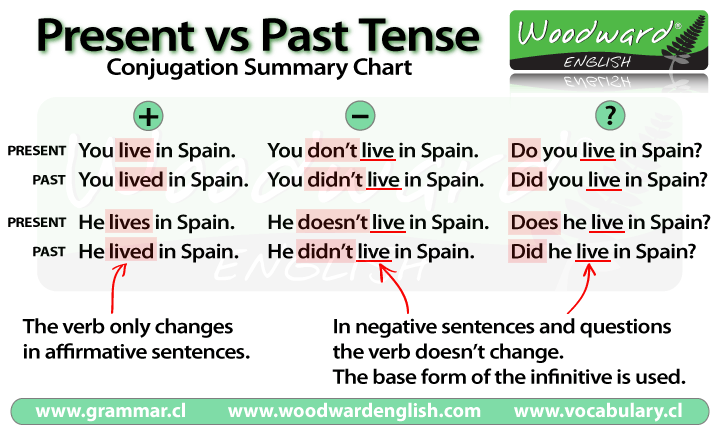
Present: They don't live in Canada.
Past: They didn't live in Canada.
The main verb (live in the example above) is in its base form (of the infinitive). The auxiliary DIDN'T shows that the sentence is negative AND in the past tense.
NOTICE: The only difference between a negative sentence in the present tense and a negative sentence in the past tense is the change in the auxiliary verb.
Both don't and doesn't in the present tense become didn't in the past tense.
Compare the negative sentences in the examples below:
Present: You don't need a mechanic.
Past: You didn't need a mechanic.
Present: You don't walk to work.
Past: You didn't walk to work.
Present: He doesn't speak Japanese.
Past: He didn't speak Japanese.

Examples of negative sentences in the Past Tense

  • didn't want to go to the dentist.
  • She didn't have time.
  • You didn't close the door.
  • He didn't come to my party.
  • They didn't study so they didn't pass the test.
  • We didn't sleep well last night.

Questions in the Past Tense

We use did to make a question in the past tense.
This is for regular AND irregular verbs in English.
(Exception is To Be and Modal Verbs such as Can)
Compare the following:
Present: Do they live in France?
Past: Did they live in France?
The main verb (live in the example above) is in its base form (of the infinitive). The auxiliary DID shows that the question is in the past tense.
NOTICE: The only difference between a question in the present tense and a question in the past tense is the change in the auxiliary verb.
Both Do and Does in present tense questions become Didn't in past tense questions.
Compare the questions in the examples below:
Present: Do you need a doctor?
Past: Did you need a doctor?
Present: Do you ride your bike to work?
Past: Did you ride your bike to work?
Present: Does he live in Italy?
Past: Did he live in Italy?
We can also use a question word (Who, What, Why etc.) before DID to ask for more information.
  • Did you study? – Yes, I did.
  • When did you study? – I studied last night.
  • Where did you study? – I studied at the library.

Examples of Questions in the Past Tense

  • Did you go to work yesterday?
  • Did they arrive on time?
  • Did she like the surprise?
  • Where did she go?
  • What did you do yesterday?
  • What did you say? - I didn't say anything.
  • Why did we have to come?

Irregular Verbs in the Past Tense

Irregular verbs are ONLY irregular in affirmative/positive sentences.
(An exception to this is with the verb TO BE in the Past Tense).
For example: The past tense of GO is WENT.
It does not end in –ED so it is considered irregular.
The word went is used for all subjects – I, you, we, they, he, she, it.
  • went to the beach
  • He went to the park.
  • She went to the zoo.
  • They went to the library.
BUT, as we mentioned before, it is only in its irregular form (went) in sentences that are affirmative/positive.
Compare the following using GO in the past tense.
  • They went to the beach
  • They didn't go to the beach --- Didn't shows that we are talking in the past tense.
  • Did they go to the beach? --- Did shows that we are talking in the past tense.
Another example with an irregular verb.
The past of EAT is ATE.
  • You ate my cake.
  • You didn't eat my cake.
  • Did you eat my cake?

Present vs Past Tense Summary Chart

Present Tense vs Past Tense Summary Chart

Some - Any - A - An

Some - Any - A - An English Grammar Rules Source:  https://www.grammar.cl/Notes/Some_Any_A_An.htm A and AN We use  A/AN  (arti...