VIDEO.
domingo, 20 de octubre de 2019

LESSON 4.2 | CAN for possibility
LESSON 4.2 | CAN for possibility
CAN / CAN'T shows ability, inability, request, permission, possibility, and inappropriateness.
Examples:
a. I can speak English.
b. You can leave early today.
c. Can I come in, please?
Formation:
Positive: Subject + CAN + Verb1
Negative: Subject + CAN'T + Verb1
NOTE: Negative form of CAN is either “cannot” or “can not” and its negative contraction is “Can’t”. In British English, it is pronounced /ka:nt/ but in American English, it is /kent/.
NOTE: Negative “YES/NO QUESTIONS” are formed in two ways:
Can Yes/No Questions and Answers Chart
Can WH Information Questions and Answers Chart
USE:
We use “CAN” to express
1. Ability
Sarven can ride a bike.
He can speak Japanese.
I can play table tennis.
We can cook.
They can eat with chop sticks.
Paul and Ingrid can ski.
2. Inability
He can’t ride a horse.
I can’t type very fast.
We can’t lift 100 kilos.
Jan can not run fast.
Alicia cannot drive a car.
3. Request
Can you help me?
Can you tell me the way to the museum?
Can you come here a minute please?
4. Permissions
Can I use your cell phone?
Can I take a day off?
Can I smoke here?
Can I go out?
Typical responses: Certainly. Yes, certainly. Of course. Of course you can. Sure (informal) … etc
5. Possibility
The florist can deliver the bouquet early.
My friend can visit me this week
Note: can is not normal used to describe future possibility in the positive form.
INCORRECT: It can rain tomorrow.
6. Inappropriateness
You can’t wear that dress! It is indecent.
You can’t smoke in this building. It is illegal.
You can’t ask for information here. This is not information desk.
Can / Can't
CAN / CAN'T shows ability, inability, request, permission, possibility, and inappropriateness.
Examples:
a. I can speak English.
b. You can leave early today.
c. Can I come in, please?
Formation:
Positive: Subject + CAN + Verb1
Negative: Subject + CAN'T + Verb1
| POSITIVE STATEMENT | NEGATIVE STATEMENT | ||||||
| I | can | speak | English | I | can't | speak | English |
| He | can | run | very vest | You | can't | run | very fast |
| He | can | sit | in the garden | He | can't | sit | in the garden |
| She | can | come | with us | She | can't | come | with us |
| It | can | jump | to the other side | It | can't | jump | to the other side |
| We | can | make | delicious cakes | We | can't | make | delicious cakes |
| You | can | pass | the exam | You | can't | pass | the exam |
| They | can | draw | pictures | They | can't | draw | pictures |
NOTE: Negative form of CAN is either “cannot” or “can not” and its negative contraction is “Can’t”. In British English, it is pronounced /ka:nt/ but in American English, it is /kent/.
NOTE: Negative “YES/NO QUESTIONS” are formed in two ways:
| 1. Can you not come today? | Can he read fast? |
| 2. Can’t you come today? | Can’t he read fast? |
Can Yes/No Questions and Answers Chart
Can WH Information Questions and Answers Chart
USE:
We use “CAN” to express
1. Ability
Sarven can ride a bike.
He can speak Japanese.
I can play table tennis.
We can cook.
They can eat with chop sticks.
Paul and Ingrid can ski.
2. Inability
He can’t ride a horse.
I can’t type very fast.
We can’t lift 100 kilos.
Jan can not run fast.
Alicia cannot drive a car.
3. Request
Can you help me?
Can you tell me the way to the museum?
Can you come here a minute please?
4. Permissions
Can I use your cell phone?
Can I take a day off?
Can I smoke here?
Can I go out?
Typical responses: Certainly. Yes, certainly. Of course. Of course you can. Sure (informal) … etc
5. Possibility
The florist can deliver the bouquet early.
My friend can visit me this week
Note: can is not normal used to describe future possibility in the positive form.
INCORRECT: It can rain tomorrow.
6. Inappropriateness
You can’t wear that dress! It is indecent.
You can’t smoke in this building. It is illegal.
You can’t ask for information here. This is not information desk.
LESSON 4.1 | THERE IS / THERE ARE
LESSON 4.1 | THERE IS / THERE ARE
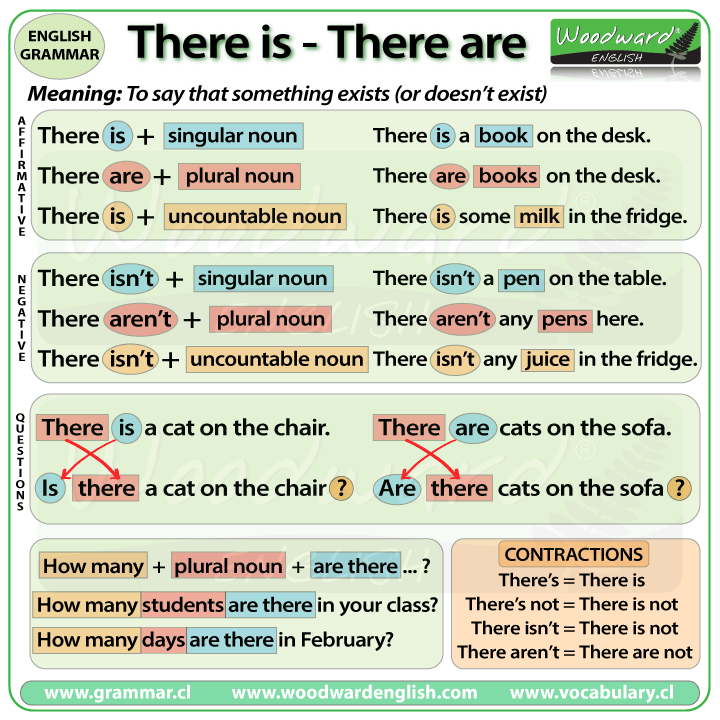
There is - There are
English Grammar Rules
We use there is and there are to say that something exists.
Positive Sentences
We use there is for singular and there are for plural.
- There is one table in the classroom.
- There are three chairs in the classroom.
- There is a spider in the bath.
- There are many people at the bus stop.
We also use There is with uncountable nouns:
- There is milk in the fridge.
- There is some sugar on the table.
- There is ice cream on your shirt.
Contractions
The contraction of there is is there's.
- There's a good song on the radio.
- There's only one chocolate left in the box.
You cannot contract there are.
- There are nine cats on the roof.
- There are only five weeks until my birthday.
Negative Form
The negative is formed by putting not after is or are:
- There is not a horse in the field.
- There are not eight children in the school.
- There is not a tree in the garden.
- There are not two elephants in the zoo.
We almost always use contractions when speaking.
The Negative contractions are:
- There's not = There isn't
- There are not = There aren't
There aren't with ANY
When we want to indicate that a zero quantity of something exists we use there aren't any.
- There aren't any people at the party.
- There aren't any trees in my street.
We also use this structure with uncountable nouns:
- There isn't any water in the swimming pool.
- There isn't any sugar in my coffee.
Questions
To form a question we place is / are in front of there.
Again we use any with plural questions or those which use uncountable nouns.
We also use there is / are in short answers.
- Is there a dog in the supermarket? - No, there isn't.
- Are there any dogs in the park? - Yes, there are.
- Is there a security guard in the shop? - Yes, there is.
- Are there any polar bears in Antarctica? - No, there aren't.
- Is there any ice-cream in the freezer? - Yes, there is.
How Many with Are There
If we want to find out the number of objects that exist we use How many in the following form:
How many + plural noun + are there (+ complement).
- How many dogs are there in the park?
- How many students are there in your class?
- How many countries are there in South America?
- How many Star Wars films are there?
domingo, 13 de octubre de 2019
CÓMO HACER EL "FAMILY TREE" (EJEMPLO)
CÓMO HACER EL "FAMILY TREE" (EJEMPLO)
HOW TO DO THE "FAMILY TREE" HOMEWORK. (WITH EXAMPLES)


jueves, 10 de octubre de 2019
HOMEWORK 3.1 | FAMILY TREE
HOMEWORK
3.1
WORK IN
PAIRS. ASK AND ANSWER QUESTIONS ABOUT YOUR FAMILY.
1. HOW MANY BROTHERS AND SISTERS DO YOU
HAVE?
2. WHAT ARE THEIR NAMES?
3. AND HOW OLD IS (HIS/HER NAME)?
4. AND DOES HE OR SHE HAVE A JOB?
NOTA: recordar que se proporcionará respuestas de ti mismo y de tu compañero, serán dos respuestas por pregunta en total.
martes, 8 de octubre de 2019
LESSON 3.3 | MAKING ARRANGEMENTS AND SUGGESTIONS.
LESSON 3.3 | MAKING ARRANGEMENTS AND SUGGESTIONS.
Before answering, think about your response. What will you suggest? What related information should you tell your friend? Think about the necessary details, such as time or location.
Key Vocabulary
Making arrangements
Think about these points when the purpose of your email is to make an arrangement.
Useful questions
Here are some typical questions used for making arrangements:
- Are you free next Tuesday afternoon?
- What time would you like to meet?
- When would be convenient for you?
- Could you please let me know?
Expressions of time
Use on with days: Could we meet on Monday?
Use in with months, years and other expressions: I'm going to visit my grandparents in October.
Use at with times and other expressions: Could you please call me at 3pm?
Use next to refer to future times: I hope we can meet again next week.
Use when to start a future time clause: Let's meet again when it is convenient.
Tenses
To speak about a timetable, use the present simple: Next term runs from 1 September until 16 December.
To speak about a future arrangement, use the present continuous: Mr Toshiko is coming to our next meeting.
To speak about a plan, use 'be going to': Next term we are going to learn about pollution.
See the talking about the future page for more practice.
Tenses in complex sentences about the future
Use the present simple after when, if and next time in future time clauses:
- I will call you when I get to the station.
- I'm going to work with my dad when I finish school.
- Let's go for a walk if the weather is good.
- Will you visit the Eiffel Tower next time you are in Paris?
MAKING SUGGESTIONS.
What Shall We Do?
In this exercise, two friends are trying to decide what to do for the weekend. By making suggestions, Jean and Chris make a decision that they're both happy with. See if you can identify where the suggestion is.
Jean: Hi Chris, would you like to do something with me this weekend?
Chris: Sure. What shall we do?
Jean: I don't know. Do you have any ideas?
Chris: Why don't we see a film?
Jean: That's sounds good to me. Which film shall we see?
Chris: Let's see "Action Man 4."
Jean: I'd rather not. I don't like violent films. How about going to "Mad Doctor Brown?" I hear it's quite a funny film.
Chris: OK. Let's go see that. When is it on?
Jean: It's on at 8 p.m. at the Rex. Shall we have a bite to eat before the film?
Chris: Sure, that sounds great. What about going to that new Italian restaurant Michetti's?
Jean: Great idea! Let's meet there at 6.
Chris: OK. I'll see you at Michetti's at 6. Bye.
Jean: Bye.
Chris: See you later!
When Jean says, "I'd rather not. I don't like violent films. How about going to 'Mad Doctor Brown?' I hear it's quite a funny film," he is making a suggestion.
More Practice
More Practice
Once you've mastered the dialogue above, challenge yourself with some additional role-playing exercises. What suggestions would you make if a friend said to you:
- Why don't you/we go to the movies tonight?
- You/we could visit New York while you're/we're there.
- Let's go to the travel agent's this afternoon to book our ticket.
- What about asking your brother for help?
- How about going to Hawaii for your vacation?
- I suggest you/we take all the factors into consideration before we decide.
If you're being asked to make a decision, that suggestion usually comes in the form of a question. For example:
- Would you like to...?
- (What) shall we go...?
If someone else has made a decision and they want your opinion, it may be made as a statement instead. For example:
- Let's go...
- Why don't we go...
- How about going...
- What about going...
Suscribirse a:
Entradas (Atom)
Some - Any - A - An
Some - Any - A - An English Grammar Rules Source: https://www.grammar.cl/Notes/Some_Any_A_An.htm A and AN We use A/AN (arti...

-
LESSON 5.1 | PAST SIMPLE & PAST CONTINUOUS (PROGRESSIVE) Do you know how to use the past continuous and past simple? L...
-
LESSON 5.1 | COUNTABLES AND UNCOUNTABLES (UNIT 5 ASO-SC1) Countable vs. Uncountable Nouns English Grammar Rules A) Most n...
-
LESSON 2.3 | PREPOSITIONS AT, IN, ON. AT - ON - IN - Prepositions of Time English Grammar Rules AT We use AT with speci...


