martes, 3 de septiembre de 2019

CRITERIOS DE EVALUACIÓN PARA LA CLASE INGLÉS I (SEGUNDO Y TERCERO PARCIAL)

CRITERIOS DE EVALUACIÓN PARA LA CLASE INGLÉS I (SEGUNDO Y TERCERO PARCIAL) 

Los criterios de evaluación para el primer cuatrimestre, modo escolarizado de UVA campus Saltillo en la asignatura de inglés I para alumnos de primer cuatrimestre modo escolarizado son los siguientes:

EXAMEN PARCIAL = 40%
PARTICIPACIÓN = 10% 
TRABAJO EN CLASE = 20%
PROYECTO O EXAMEN ORAL = 20%
TAREAS O ASIGNACIONES DOMÉSTICAS = 10%

NOTA: Si tuviste más de 3 asistencias eso representa un detrimento en tu evaluación, porque después de 5 faltas cada inasistencia representa de tres hasta 6 décimas de punto de tu promedio de parcial.

CRITERIO EN MATERIA DE FALTAS Y RETARDOS.
LA TOLERANCIA DE RETARDOS O DEMORAS DE ASISTENCIA son 3 veces, a partir del tercer retardo se convierte inmediatamente en una falta.
La tolerancia de faltas para tener derecho al examen parcial o mensual es de 5 faltas, al rebasar ese número su derecho a la prueba se anula por completo perdiendo así la oportunidad de cumplir con el 40% de su evaluación parcial.


PUEDES
NO PUEDES

EXAMEN MENSUAL (PARCIAL)

Faltar 5 veces
6 o más faltas

EXAMEN FINAL

15 insasistencias máximo
16

EXAMEN EXTRAORDINARIO

16 – 20 inasistencias máximo
21

EXAMEN DE TITULO DE INSUFICIENCIA

21 - 25 inasistencias
26

RECURSAR

26 inasistencias o más


sábado, 31 de agosto de 2019

LESSON 1.3 | MAKING REQUESTS (ASO EL 1 - UNIT 1)

LESSON 1.3 | MAKING REQUESTS (ASO EL 1 - UNIT 1)

MAKING REQUESTS


Can
Could
I
Have
A sándwich, please?
One of those batteries, please?
A round trip ticket to Paris, please?


Use Can/Could + / + infinitive to make requests.

Note: could is often formal and polite than can.

Reply. Yes, of course. Here you are.


VIDEO ACERCA DEL TEMA (CONTIENE INFORMACIÓN PARA AVANZADOS)

LESSON 1.2 (PART 4) | POSSESSIVE 'S (ASO EL 1 - UNIT 1)

Possession (John’s cara friend of mine)

Possessive ’s

We use apostrophe s (’s), also called possessive ’s, as a determiner to show that something belongs to someone or something:
Is that Olivia’s bag?
Britain’s coastline is very beautiful.
We can also use it in complex noun phrases (underlined):
Greg is her youngest daughter’s husband.
We can use two possessive ’s constructions in the same noun phrase:
We went to Jake’s father’s funeral.
We also use possessive ’s to talk about time and duration:
Is that yesterday’s paper?
I’ve only had one week’s holiday so far this year.

Rules for using possessive ’s

We use ’s after a singular noun and  after a plural noun.
Compare

singular noun + ’s
plural noun + ’
The girl’s bedroom
(The bedroom belongs to one girl.)
The girls’ bedroom.
(The bedroom belongs to more than one girl.)
We use ’s with irregular plural nouns (e.g. children, men, people, women):
The children’s parents decided which university they would go to.
They have no respect for other people’s property.
The rules for the pronunciation of a noun with ’s are the same as the rules for pronunciation of plural forms of nouns.
Compare

noun + ’s or 
plural noun
pronunciation
The cat’s dinner is in the fridge.
The cats were running around the garden.
/s/
The kids’ uncle gave them all some money.
The kids are getting impatient.
/z/
George’s brother was there.
There are three Georges in my family.
/ɪz/
When a first or second name ends in -s, we can either add  or ’s. It is more common to use  than ’s. When we speak, we usually pronounce the final part of the word as /zɪz/ or /sɪz/:
Is that James car? (or Is that James’s car?) (both usually pronounced /ˈdʒeɪmzɪz/)
I love Keats’ poetry. (or I love Keats’s poetry.) (both usually pronounced /ˈki:tsɪz/)
With compound nouns, we add ’s to the final noun:
My sister-in-law’s friend came with us.
Not: My sister’s-in-law friend
We don’t usually use the possessive ’s with things:
the door handle
Not: the door’s handle
the shop window
Not: the shop’s window
the kitchen table
Not: the kitchen’s table
Spoken English:
When we talk about places which are familiar to the speaker and the listener, we sometimes don’t use the noun after possessive ’s:
the hairdresser’s salon – the hairdresser’s
the doctor’s surgery – the doctor’s
We had to take our cat to the vet’s twice last month. (the same as: We had to take our cat to the vet’s clinic twice last month.)
Do you shop in Marks and Spencer’s?
We decided to go to John’s after the cinema. (the same as: We decided to go to John’s house after the cinema.)
In short answers, we can omit the noun if it is not necessary to repeat it:
A:
Is that your coat?
B:
No, it’s Sandra’s.
We use possessive ’s with words such as one, anyone, someone, anybody, somebody:
It’s important to know one’s rights as a tenant.
Is this someone’s coat here?
When we use else with these words, the ’s is added to else:
Why didn’t you come? Everyone else’s husband was there.
Warning:
The pronoun other has the same forms as nouns. We add ’s to the singular form, and we add an apostrophe after the plural -s ending in the plural form:
They took each other’s hand and started walking.
All of our luggage arrived but the others’ cases didn’t. The airline promise they will be here this evening.
Warning:
We don’t use ’s with possessive pronouns:
Is that dog yours?
Not: Is that dog your’s?
I think that car is theirs.
Not: I think that car is theirs’
We don’t use ’s with the possessive determiner its. It’s means ‘it is’:
The city is proud of its parks.
Not: The city is proud of it’s parks.

Possessives with of

Noun phrase + of + possessive pronoun

We can talk about possession using the pattern: noun phrase + of + possessive pronoun:
A friend of mine told me that all of the tickets have already sold out.
A:
Where’s Martin?
B:
He’s gone to pick up a cousin of his at the station.
Is Linda McGrath a close friend of yours?
Warning:
We use a possessive pronoun, not the object form of the pronoun:
A neighbour of mine called late last night.
Not: A neighbour of me …

Noun phrase + of + possessive ’s noun phrase

We can also use the noun phrase + of pattern before a noun phrase with possessive ’s:
He’s a brother of Maria’s.
A friend of my sister’s has opened a café on Dawson Street.
She was a daughter of the President’s.

’s or of or either?

There are some general rules about when to use ’s and when to use of but there are many cases where both are possible:
The film’s hero or The hero of the film
The car’s safety record or The safety record of the car
The report’s conclusion or The conclusion of the report
Sometimes when we first mention a noun, we use of, and later when we refer to it again, we use ’s:
The mountains of Pakistan are mostly in the north. At least one hundred of them are above 7,000 metres … Most of Pakistan’s mountains are in the spectacular Karakoram range.

When we don’t use ’s

We don’t use ’s when the noun is not a person, animal, country, organisation, etc., or when the noun phrase is very long:
The name of the ship was ‘Wonder Queen’. (preferred to The ship’s name was ‘Wonder Queen’.)
The house of the oldest woman in the village. (preferred to The oldest woman in the village’s house.)

When we don’t use of

When we are talking about things that belong to us, relationships and characteristics of people, animals, countries, categories, groups or organisations made up of people, we usually use ’s:
The men’s dressing room is on the left at the end of the corridor.
Not: The dressing room of the men …
The cat’s paw was badly cut.
Not: The paw of the cat …

Possession: typical errors

  • We don’t use ’s with plural nouns:
It’s my responsibility to deal with customers’ complaints.
Not: … to deal with customers's complaints.
  • The possessive determiner its has no apostrophe:
We bought this car because we liked its colour.
Not: … because we liked it’s colour.
  • We don’t use ’s to make nouns plural. When we want to show that something is plural, we add -s without an apostrophe:
They had to rebuild the roads after the earthquake.
Not: They had to rebuild the road’s …

LESSON 1.2 (PART 3) | POSSESSIVE ADJECTIVES (ASO EL 1 - UNIT 1)

Possessive Adjectives

English Grammar Rules


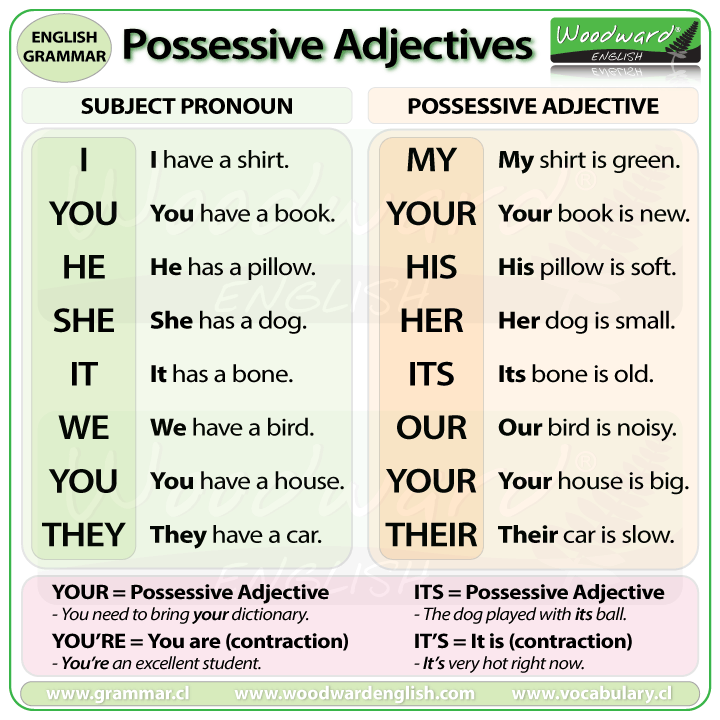
Possessive adjectives are used to show possession or ownership of something. While we use them when we refer to people, it is more in the sense of relationship than ownership.
The possessive adjectives in English are as follows:
Possessive Adjectives in English with examples
The possessive adjective needs to agree with the possessor and not with the thing that is possessed.
Examples
  • My car is very old.
  • Her boyfriend is very friendly.
  • Our dog is black.
  • Their homework is on the table.
Like all adjectives in English, they are always located directly in front of the noun they refer to. (Possessive Adjective + Noun)
We do not include an S to the adjective when the noun is plural like in many other languages.
Examples:
  • Our cars are expensive. (Correct)
    Ours cars are expensive. (Incorrect)
However, the verb that is used needs to be in agreement with the noun - if the noun is singular then the verb is singular; if the noun is plural then the verb is plural.
Examples:
  • My pen is black. (Singular)
    My pens are black. (Plural)
  • Our child is intelligent. (Singular)
    Our children are intelligent. (Plural)

Its vs. It's

Be careful not to confuse its and it's.
Its = The possessive adjective for It.
It's = a contraction of it is.
More detailed information about Its vs. It's here.
See the difference between Your and You're and Their, They're, and There

LESSON 1.2 (PART 2) | POSSESSIVE PRONOUNS (ASO EL 1 - UNIT 1)

Possessive Pronouns

English Grammar Rules

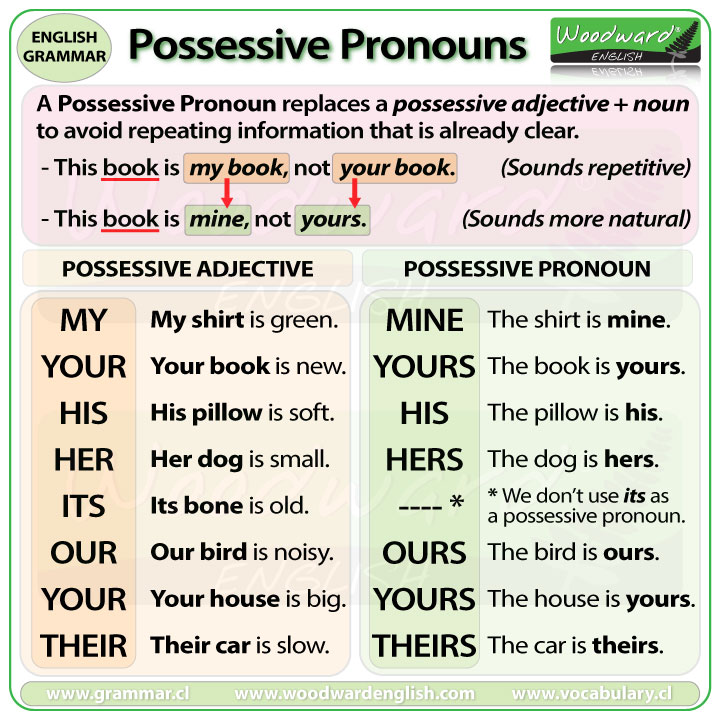
Possessive pronouns are used in English to avoid repeating information that is already clear. In general it makes the sentence less confusing because the same information is not being repeated.
This book is my book, not your book. (Sounds repetitive)
This book is mine, not yours. (Mine and yours are possessive pronouns)
In the sentence, mine is a possessive pronoun that replaces my book.
In the sentence, yours is a possessive pronoun that replaces your book.
The possessive pronouns in English are as follows:
SubjectPossessive
Pronouns
IMine
YouYours
HeHis
SheHers
It--- *
WeOurs
You (pl)Yours
TheyTheirs
* We avoid using the possessive pronoun ITS.
Examples:
  • I didn't have my umbrella so Marta lent me hers.
    (I didn't have my umbrella so Marta lent me her umbrella).
  • Her car is faster than mine.
    (Her car is faster than my car).
  • That food is ours and not theirs.
    (That food is our food and not their food).
  • I know this drink is yours but I need to drink something.
    (I know this drink is your drink but I need to drink something).
Remember that with possessive pronouns there are no apostrophes (').
Possessive Pronouns in English

LESSON 1.2 (PART 1) | This/That, These/Those | POSSESSIVE PRONOUNS (ASO EL 1 - UNIT 1)

LESSON 1.2 | This/That, These/Those | POSSESSIVE PRONOUNS (ASO EL 1 - UNIT 1)


This - That - These -Those

English Grammar Notes - Demonstratives


This, That, These, Those are called demonstratives and they are used to show the relative distance between the speaker and the noun.

Demonstrative Pronouns

We use this (singular) and these (plural) to refer to something that is here / near.
Examples:
  • This is my car. (singular)
  • These are our children. (plural)
We use that (singular) and those (plural) to refer to something that is there / far.
Examples:
  • That is our house. (singular)
  • Those are my shoes. (plural)
Note that the verb changes (i.e. singular / plural) depending on the pronoun that you use.
You can also use Demonstrative Pronouns by themselves:
  • Did you do that?
  • I'd like to buy these?
  • Which of those would you like?

Demonstrative Adjectives

You can also use demonstratives before a noun. These are called demonstrative adjectives.
The Demonstrative Adjective needs to agree (= be the same form) as the noun.
Examples of demonstrative adjectives:
  • This party is boring. (singular)
  • That city is busy. (singular)
  • These chocolates are delicious. (plural)
  • Those flowers are beautiful. (plural)

Summary - What is the difference between Demonstrative Adjectives and Demonstrative Pronouns?

Demonstrative Adjectives and Demonstrative Pronouns use the same words. The easiest way to know that difference is that Demonstrative Adjectives are always before a noun while Demonstrative Pronouns are before a verb or by themselves.
  • This book is old. (Demonstrative Adjective + Noun)
  • This is new. (Demonstrative Pronoun + Verb)
  • Did you like that? (Demonstrative Pronoun by itself)
Everything else is the same. For example, both Demonstrative Ajectives and Pronouns use the word THIS (singular) to talk about something that is close to you and the plural of THIS is THESE.

Present vs. Past

If an action is near in time we tend to use this / these.
If an action has finished or is in the past we use that / those.
Examples:
  • This is a good meal. (at the time of eating)
  • Those girls we met last night were silly. (an event that happened in the past).

This is

The expression this is is commonly used when you talk on the phone or you introduce people.
Examples:
  • "Hello, this is Peter."
  • Carol, this is my friend Simon. Simon, this is Carol.

Summary Chart


Some - Any - A - An

Some - Any - A - An English Grammar Rules Source:  https://www.grammar.cl/Notes/Some_Any_A_An.htm A and AN We use  A/AN  (arti...